You got a text back that just says “DND” and now you’re stuck guessing. Is your friend mad? Busy? On a plane? DND simply means “Do Not Disturb.” It’s one of the most common texting abbreviations in the U.S., and once you know how it’s used, you’ll never second-guess it again.
This guide breaks down the exact meaning, where it comes from, and how people actually use it in real texts, apps, and everyday slang.
Table of Contents
What Does DND Mean in Texting? (Quick Definition)
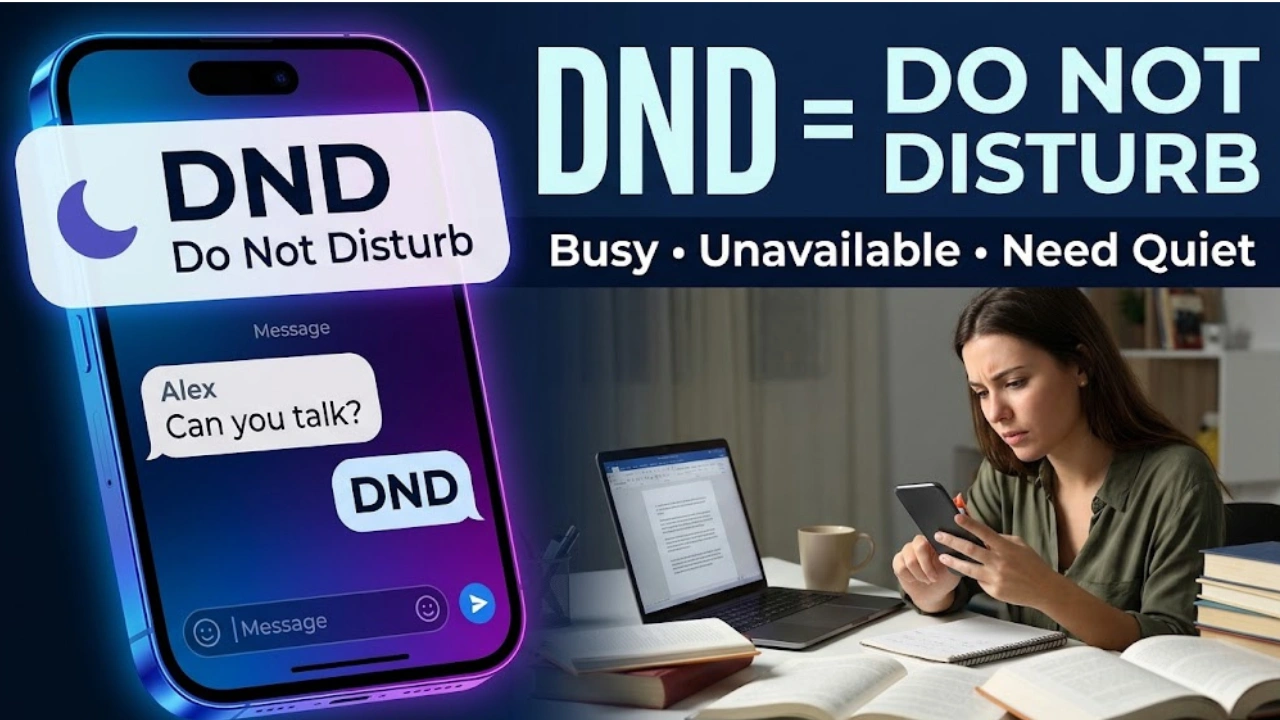
DND stands for “Do Not Disturb.” In texting, it’s a quick way to tell someone you’re busy, unavailable, or need quiet time without writing a full sentence.
People send a plain “DND” text before a meeting, during a study session, or while trying to sleep. It’s short, direct, and everyone understands it instantly. That’s exactly why it caught on — texting rewards short, fast communication, and DND does the job in three letters.
You’ll also see it as a status label on messaging apps like WhatsApp, Slack, or Instagram, where a small icon shows a contact has turned notifications off.
What Does DND Stand For? (Origin & Full Form)
DND stands for “Do Not Disturb,” full stop. But the letters get borrowed for different things depending on where you see them, so it helps to know the difference.
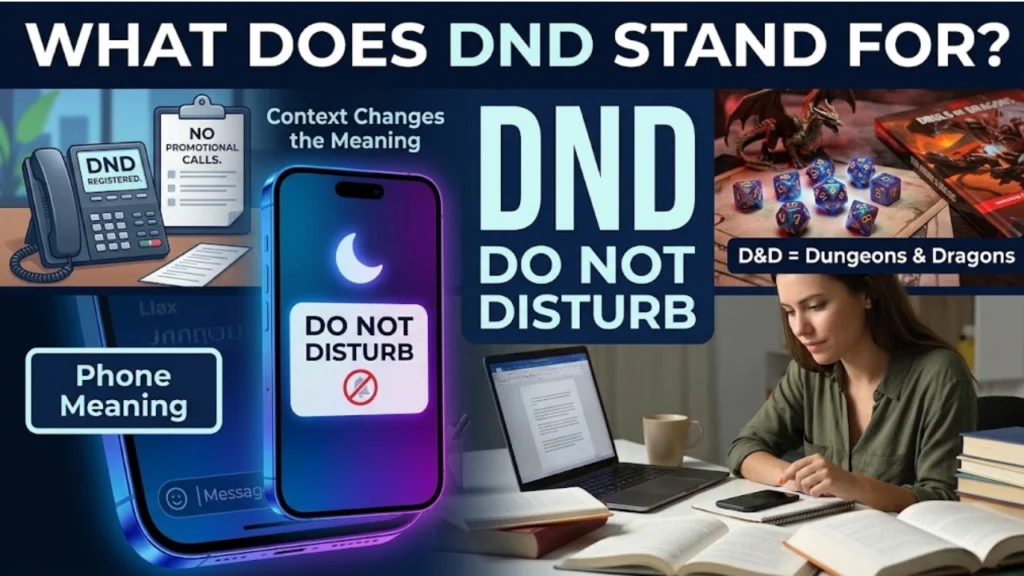
In texting and phone settings, DND is a personal availability signal — a phone feature that silences calls and notifications.
In tabletop gaming, D&D usually refers to Dungeons & Dragons, a completely unrelated tabletop role-playing game. Context always makes it obvious which one is meant — nobody writes “brb, in the middle of a Do Not Disturb campaign.”
In telecom and marketing, “DND” also refers to Do Not Disturb registries — official lists that let people block promotional calls and texts from businesses. This is a regulatory term, separate from the casual texting phrase, and mostly shows up in business or legal contexts rather than personal chats.
Knowing these three lanes keeps you from mixing them up when the acronym pops up outside a group chat.
Different Ways DND Is Used in Texting
DND shows up in more places than just a one-word reply. Here’s where you’ll actually run into it.
As a phone setting, iPhone and Android both have a built-in Do Not Disturb mode that silences calls, texts, and app alerts. According to a national driver survey by CMT, roughly 62% of U.S. drivers are aware of the Do Not Disturb While Driving feature, though usage is much lower — only about 20% turn it on regularly (cmtelematics.com). A separate AAA on-road study found that training drivers to use the feature cut smartphone interactions by 41% (AAA Northeast) — proof that this small setting has a measurable real-world impact.
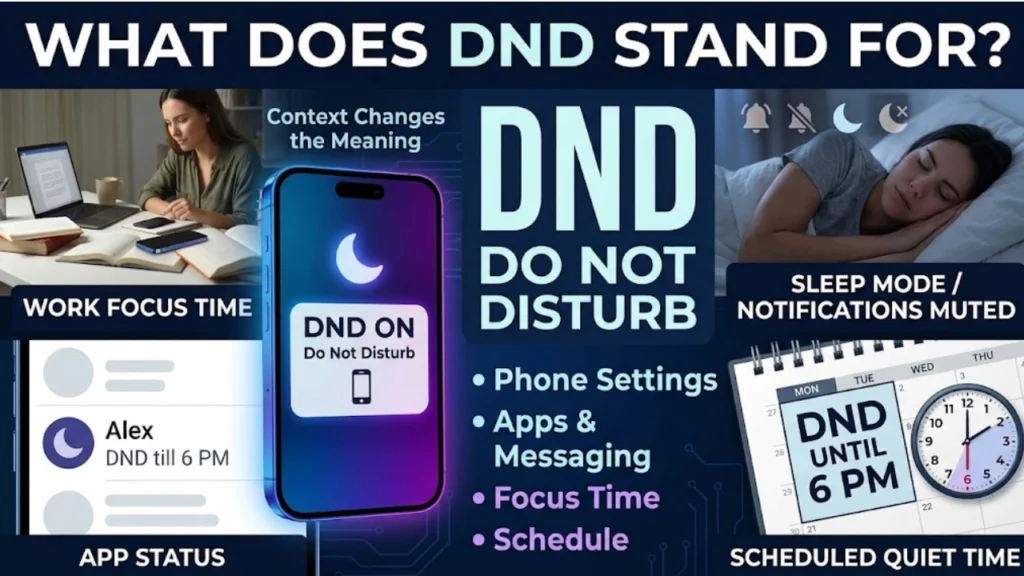
As an app status, messaging platforms like WhatsApp and Slack let users mute notifications and show a moon icon or “DND” tag to contacts, so people know not to expect a fast reply.
As a spoken or typed phrase, people simply text “DND” or “on DND” to explain why they went quiet, without needing an app setting at all. It works as a boundary-setting shortcut — polite, quick, and low-effort.
As a scheduling cue, some people set DND hours around sleep, work blocks, or focus time, then text friends “DND till 6” so nobody wonders where they went.
DND Meaning in Slang & Gen Z Texting
Gen Z has stretched DND beyond its literal meaning, and that shift is worth understanding on its own.
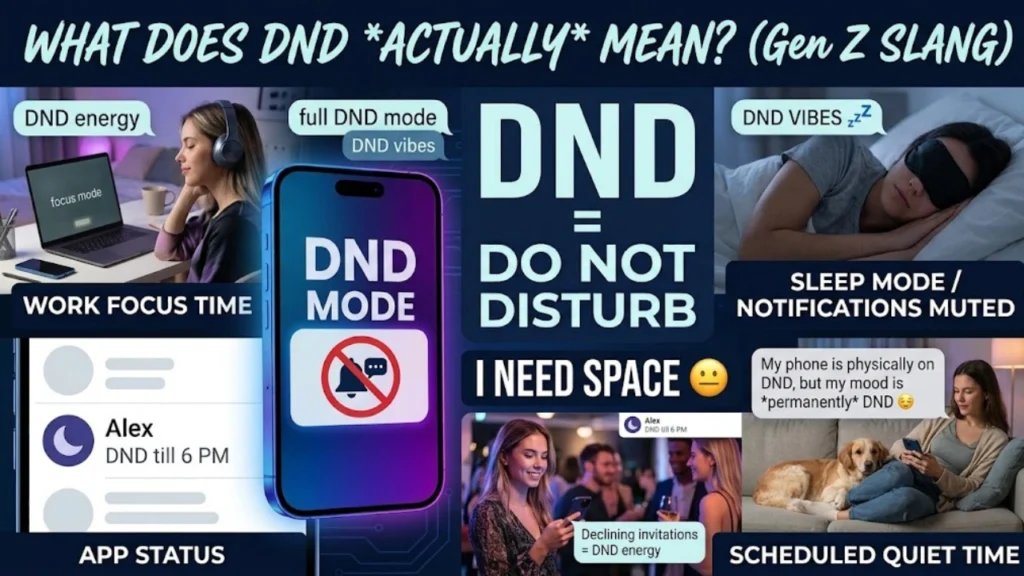
In Gen Z slang, “DND” often signals a mood, not just a setting. Someone might caption a photo “DND energy today” to mean they’re feeling withdrawn, low-key, or simply not in a social mood — no actual phone setting involved.
It also shows up as an identity label. Saying “I’m a DND person” can mean someone prefers texting over calling, values alone time, or just doesn’t like being reachable 24/7. This usage leans emotional and personal rather than purely functional.
You’ll spot it in bios, captions, and casual texts like:
“ignore me today, full DND mode 🚫”
“sorry I didn’t answer, I was on DND”
“she’s giving DND vibes rn”
This slang shift matters because it shows how a simple phone feature turned into a small piece of digital communication culture — a way to signal boundaries without sounding harsh.
DND Meaning for Girls & in Relationships and Dating Texts
DND carries a slightly different weight in dating and relationship texting, where tone and timing matter more.
When a girl texts “I’m on DND” or “on DND, talk later,” it’s usually a boundary-setting move, not a rejection. It can mean she’s busy, needs space, or is simply prioritizing something else for a while — schoolwork, sleep, family time, or mental reset.
In dating conversations, DND can also soften a pause without ending things. Instead of leaving someone on read with no explanation, sending “DND for a bit, I’ll text you tonight” keeps communication respectful while protecting personal time.
A good reply when someone says they’re on DND: something short and low-pressure, like “no worries, talk whenever you’re free.” Pushing for an immediate response defeats the entire purpose of the message.
Understood this way, DND isn’t cold — it’s a small courtesy that keeps digital communication considerate on both ends.
FAQs
What does DND mean in Gen Z?
Among Gen Z, DND often means more than a phone setting — it can describe a mood, a personality trait, or a way of saying “I need space right now,” used in captions, bios, and casual texts.
What does DND mean in slang?
As slang, DND is shorthand for being unavailable or wanting quiet time. It’s used loosely to explain silence, low energy, or a need for a break from constant messaging.
What does DND mean for girls?
For girls, texting “on DND” usually signals a personal boundary — busy, resting, or focused elsewhere — not a sign of anger or disinterest.
What does DND stand for?
DND stands for “Do Not Disturb.” The exact context (phone setting, gaming, or telecom regulation) decides which specific meaning applies.
Conclusion
DND simply means “Do Not Disturb” — a short, clear way to signal you’re unavailable, whether it’s a phone setting, a slang term, or a boundary in a text conversation. Once you know the context, the meaning is never confusing again.
Jack Waseem is the founder and lead editor of MeaningsLoop. He started the site out of a simple frustration: too many word-meaning searches online led to cluttered pages, thin definitions, and content clearly written for search engines rather than for people. Jack set out to build something closer to a well-kept paper dictionary — dependable, clearly written, and genuinely useful.