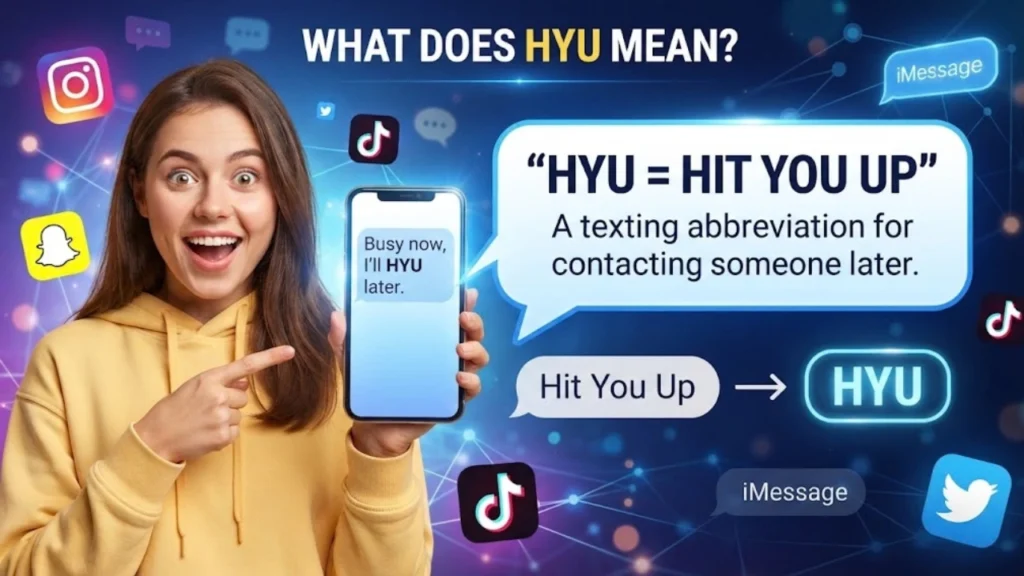
Your friend texts, “Busy now, I’ll HYU later.” You stare at the screen. What does it mean?
HYU stands for “hit you up.” It is a texting abbreviation that means “I will contact you later.”
This guide gives you the exact definition, real examples, reply ideas, and safe alternatives. It is written for US texters on Snapchat, Instagram, and TikTok.
Table of Contents
What Does HYU Mean in Text? Definition and Origin
The HYU meaning in text is simple: the sender plans to message or call you soon. Dictionary.com lists HYU as slang for “hit you up,” used in texting and on social media, and calls it the counterpart of HMU. You can read the full entry here. dictionary
HYU is an initialism. You say each letter: “H-Y-U.” It is not said as one word.
The phrase “hit you up” comes from spoken American English. It means to reach out to someone in a casual way. Texting cut it down to three letters to save time.
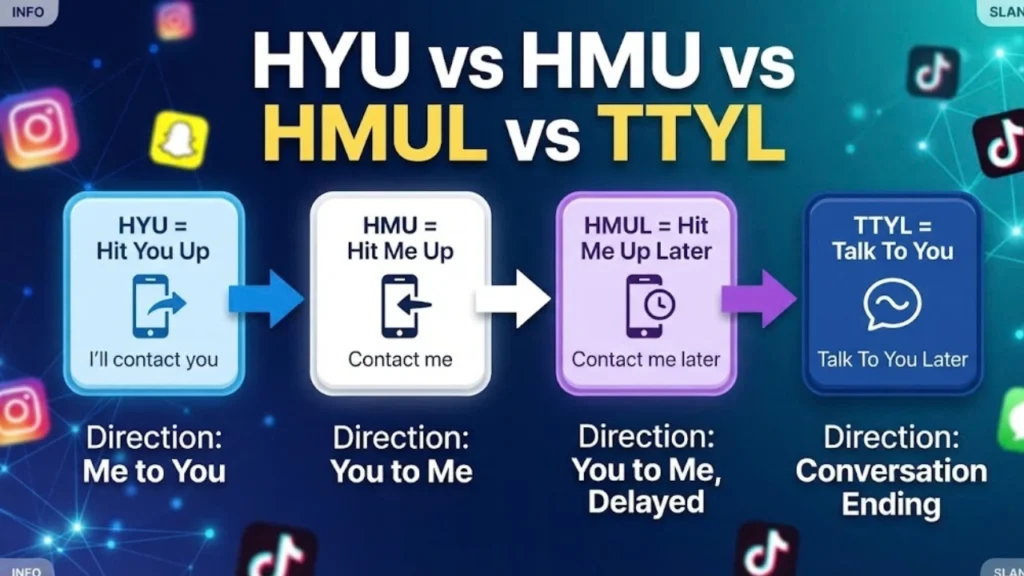
Here is how HYU compares with similar texting slang:
Slang
Full form
Who reaches out?
HYU
Hit you up
The sender
HMU
Hit me up
The receiver
HMUL
Hit me up later
The receiver
TTYL
Talk to you later
Nobody in particular
HYU makes a small promise: “I’ll start the next chat.” TTYL only says goodbye. That is the key difference.
Rare meanings exist too. In gaming chat, HYU can mean “hear you.” Some people also type it as a quick “how you?” Context tells you which one it is.
How to Use HYU in Text: Examples by Platform and Tone
You can use HYU when you are busy but want to keep a chat alive. It works best with friends.
Here are common HYU examples in text:
Busy moment: “In class rn. HYU after.”
Making plans: “Let me check my schedule and HYU tonight.”
Ending a chat: “Gotta run. HYU tomorrow.”
Dating chat: “Had fun tonight. HYU tomorrow.”
Gaming: “HYU when the match starts.”
Each platform feels a bit different. On Snapchat, replies are quick and short. On Instagram DMs, people use HYU to pause a talk. On TikTok, it shows up in comments and private messages. On Discord, it often points to an event or a game session.
Tone changes everything. “I’ll HYU later!” sounds friendly. “Yeah, I’ll HYU.” can sound cold. “Busy. HYU.” sounds rushed.
Not sure what someone means? Check the topic, the tone, the app, and the earlier messages. Those four clues almost always solve it.
Young adults text the most. A 2011 Pew Research Center survey found that Americans aged 18 to 24 exchanged about 109.5 texts on a normal day. That volume is why short forms like HYU spread so fast. pewresearch
Not sure how to respond to HYU? Keep it short and match the sender’s mood.
Casual: “Sounds good.” or “Cool, talk later.”
Friendly: “Okay, text me when you’re free!”
Respectful: “No problem, take your time.”
Boundary: “Text me tomorrow instead. I’m offline tonight.”
Use HYU with friends, family, and close contacts. Skip it with a boss, a client, or a teacher. Professional alternatives are clearer. Try “I’ll follow up later today” or “I’ll message you soon.”
One risk is worth knowing. If someone says HYU and never does, it can feel like ghosting. A short line like “Still on for tonight?” fixes that.
FAQ’s
What is HYU short for?
HYU is short for “hit you up.” It means the sender will contact you later.
What does hy mean in text from a girl?
“Hy” is usually a fast typo or short form of “hey” or “hi.” It is a friendly greeting. If she writes “HYU,” she means she will message you later. Read the tone and the chat history to be sure.
What is a hu in slang?
“Hu” is usually a quick typo or short form of “who.” It can also be a lazy “huh.” It is not the same as HYU. The sentence around it shows the meaning.
What does * u mean?
An asterisk often marks a typo fix, such as “*you.” It can also hide a censored word. Look at the message before it to tell which one it is.
Conclusion
HYUmeans “hit you up.” It is casual, friendly, and points to future contact. HMU flips the roles, and TTYL just says bye.
Jack Waseem is the founder and lead editor of MeaningsLoop. He started the site out of a simple frustration: too many word-meaning searches online led to cluttered pages, thin definitions, and content clearly written for search engines rather than for people. Jack set out to build something closer to a well-kept paper dictionary — dependable, clearly written, and genuinely useful.