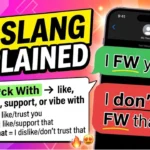
You typed “thank you,” and someone replied with just “yw.” No punctuation. No explanation. Just two letters.
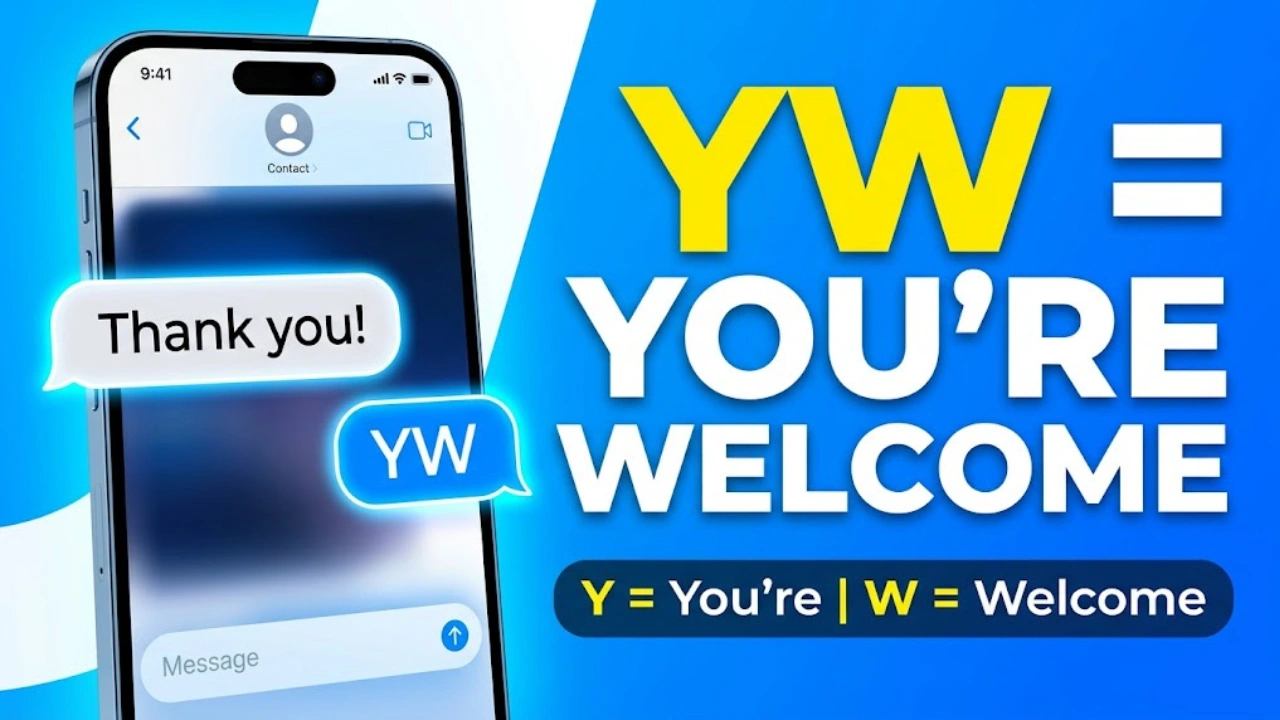
Here’s the short answer: YW means “you’re welcome.” It’s a fast, casual reply people use in texts, DMs, and comments right after someone says thanks. That’s it. No hidden meaning, no trick — just a shortcut for good manners.
What Does YW Mean? (Quick Definition)
YW stands for “you’re welcome.” It’s an initialism, which means each letter stands for a word — Y for “you’re,” W for “welcome.”
People use it as a direct reply to “thank you,” “thanks,” or “ty.” It shows up everywhere from text messages to Instagram comments to gaming chats.
Capitalization doesn’t change the meaning. “YW” and “yw” mean the exact same thing — most people just type it lowercase because it’s faster.
Texting rewards speed. The fewer keystrokes, the better. That’s the whole reason shorthand like yw, ty, and np exist.
This habit isn’t new. Text abbreviations trace back to early SMS and instant-messaging culture in the late 1990s and early 2000s, when phone keypads made typing slow and character limits were tight. People needed a quick way to close a “thank you” loop without typing a full sentence, and yw filled that gap.
There’s also a social reason behind it. Replying to thanks — even with two letters — completes a small conversational exchange. Linguists call this an adjacency pair: one message (thanks) naturally expects a matching response (you’re welcome). Skipping the reply can feel awkward, even in casual chat. Yw lets people close that loop instantly.
Is It Rude to Just Say YW? Tone and Context
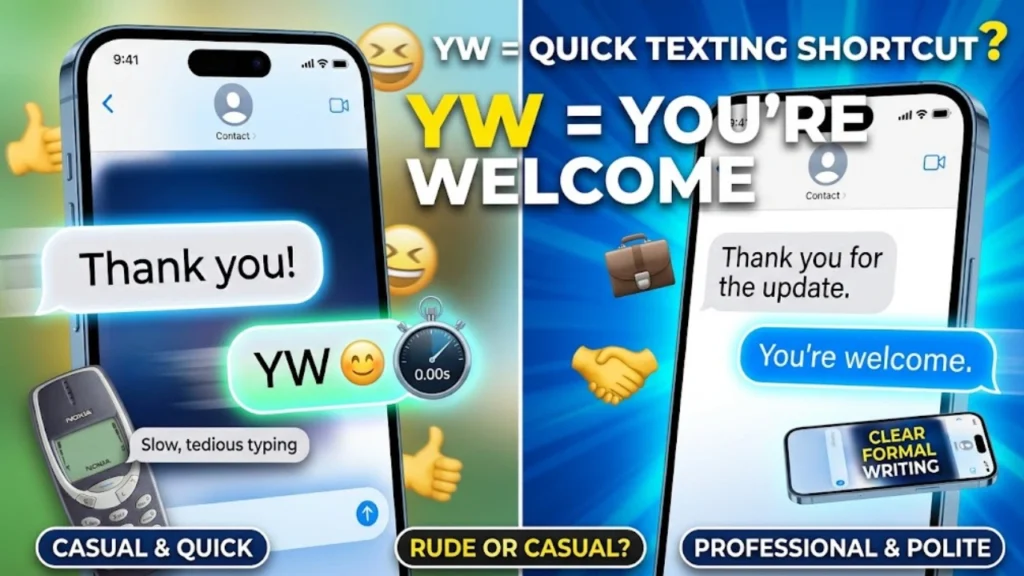
A short reply isn’t automatically a cold one. In texting, brevity is the norm, not an insult.
Yw works well in casual settings — friends, family group chats, social media comments, gaming lobbies. Nobody expects a full sentence in these spaces.
Formal settings are different. In a work email, a message to a client, or a conversation with your boss, spelling out “you’re welcome” reads as more professional. Save yw for people you’d text casually, not people you’d address as “Dear Mr. Smith.”
A simple rule: match your reply length to the message you received. If someone sent a quick “ty,” a quick “yw” fits perfectly. If someone wrote a heartfelt thank-you message, a slightly longer reply shows you actually read it.
YW in Texting and Social Media (With Examples)
Seeing yw in real conversations makes the meaning click faster than any definition.
Text message: Friend: “Thanks for picking me up!” You: “yw, anytime!”
Instagram comment: Follower: “Love this post, thank you for sharing!” You: “yw 😊”
Gaming chat: Teammate: “ty for the assist” You: “yw, gg”
A few close cousins of yw show up in the same spaces:
YVW – “you’re very welcome,” a slightly warmer version
YWA – “you’re welcome anyway,” common in forums
UW – a shorter, casual spin on “you’re welcome”
These variations all point back to the same core idea: acknowledging someone’s thanks without typing it all out.
Other Ways to Say YW (You’re Welcome Alternatives)
Sometimes yw feels too short for the moment. Plenty of alternatives carry the same meaning with a different tone.
For a casual, friendly reply, try: no problem, anytime, no worries, sure thing.
For a warmer, more personal tone, try: my pleasure, glad I could help, of course.
For a professional setting, try: you’re very welcome, happy to help, I’m glad it worked out.
Choosing the right one comes down to context — who you’re talking to, and how much warmth the moment calls for.
FAQ’s
What does “yw” mean in chat?
In chat, yw means “you’re welcome.” It’s sent as a quick reply right after someone types “thank you” or “ty.”
What does yw stand for?
Yw stands for “you’re welcome.” The Y represents “you’re” and the W represents “welcome.”
Is yw your welcome?
Not quite — the correct phrase is “you’re welcome,” not “your welcome.” Yw is short for the contraction “you’re” (you are), not the possessive word “your.”
What does yw and ty mean?
Ty means “thank you” and yw means “you’re welcome.” Together, they form a complete back-and-forth: one person says thanks, the other replies with yw.
Conclusion
Yw simply means “you’re welcome.” It’s quick, it’s casual, and it’s built for fast-moving conversations — texts, comments, and chats where a full sentence isn’t necessary. Save it for informal chats, spell it out for formal ones, and you’ll never misuse it again.
Jack Waseem is the founder and lead editor of MeaningsLoop. He started the site out of a simple frustration: too many word-meaning searches online led to cluttered pages, thin definitions, and content clearly written for search engines rather than for people. Jack set out to build something closer to a well-kept paper dictionary — dependable, clearly written, and genuinely useful.