You saw SNM in a text or a tweet, and now you’re stuck. Is it slang? A secret code? A typo?
Here’s the short answer: SNM stands for “say no more.” People use it when they fully understand something and don’t need extra explanation. It’s one of the most common text abbreviations on social media today, especially on Twitter/X, Instagram, and Snapchat.
This guide breaks down the SNM meaning, shows you exactly how to use it, and clears up the confusion around lookalike terms like SM, SMN, and SMW.
Table of Contents
What Does SNM Mean in Text?
SNM is a fast way of saying “I get it, no more explanation needed.”
When someone texts you SNM, they’re telling you the message landed. They agree, they understand, and they don’t need any more details. It’s a small acronym that carries a big meaning: trust, agreement, and quick understanding.
You’ll spot it most in casual conversations — texting, group chats, and comment sections. It’s informal, so it rarely shows up in professional emails or formal writing. Think of it as a digital nod of the head.
“I need someone I can count on for this project.” “SNM. I’ve got you.”
Where SNM Comes From and Why It Caught On
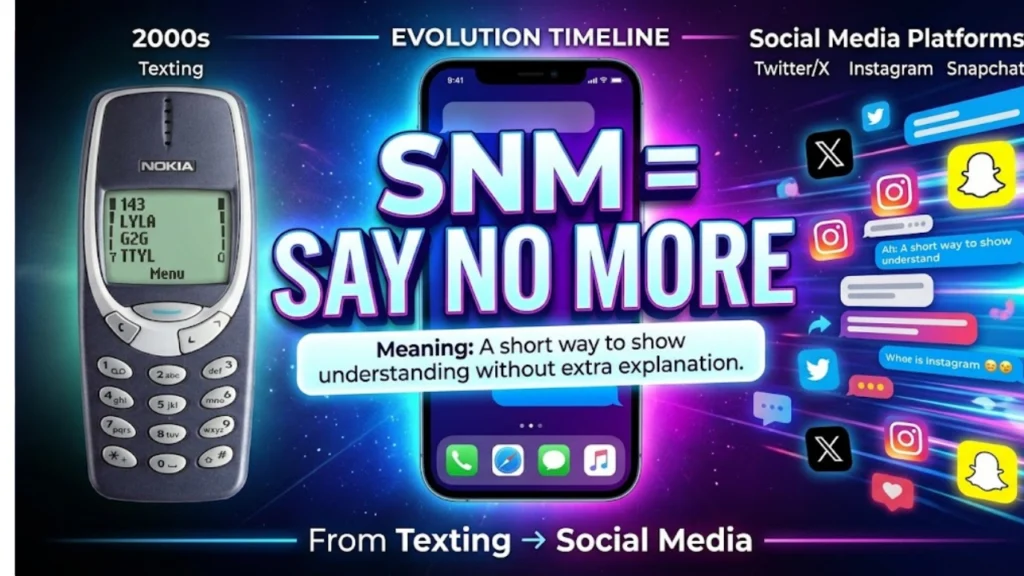
Internet slang moves fast, and SNM grew out of that speed. It’s believed to have started circulating in texting culture in the early 2000s, when short abbreviations became the norm for saving time and keystrokes.
Texting itself pushed this trend hard. Pew Research has tracked how heavily Americans rely on text messaging for daily communication, and that habit created the perfect environment for acronyms like SNM to spread — Pew Research Center’s data on U.S. texting habits shows just how central short-form messaging has become in everyday life.
SNM picked up real momentum on Twitter, where character limits reward brevity. From there, it jumped to Instagram captions, Snapchat replies, and everyday group chats. It’s a good example of how internet slang doesn’t stay in one lane — it travels across platforms and sticks around when it’s genuinely useful.
How to Use SNM in a Text or on Social Media
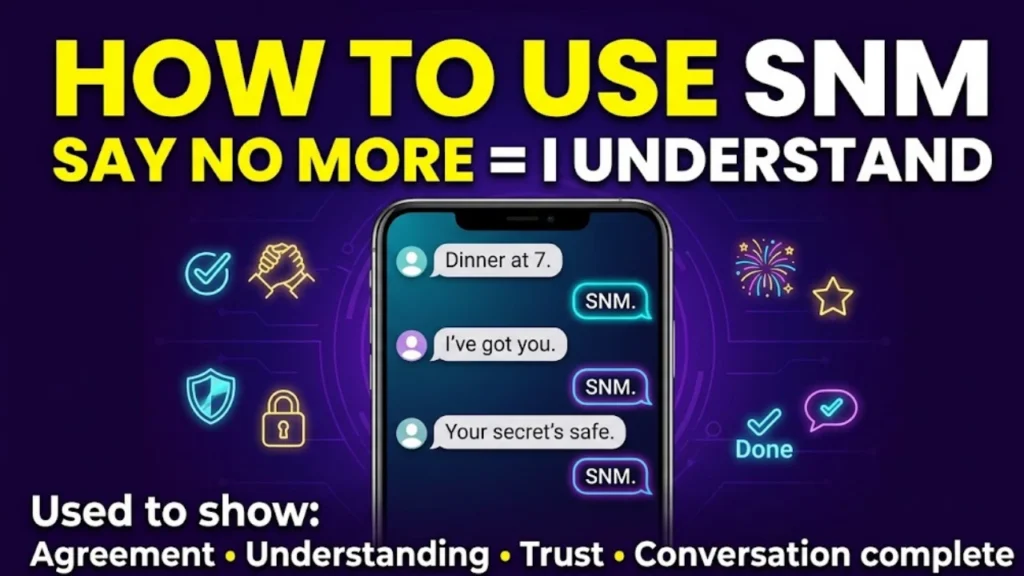
SNM works in a handful of everyday situations. Here’s how people actually use it.
Agreeing or acknowledging something:
“Dinner’s at 7, don’t be late.” “SNM.”
Showing excitement:
“Concert tickets just dropped.” “SNM, I’m buying now!”
Wrapping up a conversation:
“That covers everything for the trip.” “SNM.”
Building trust:
“I need this handled quietly.” “SNM, consider it done.”
Keeping something private:
“Don’t repeat this to anyone.” “SNM, your secret’s safe.”
How should you reply to SNM? Keep it simple. A quick “thanks,” “got it,” or even a thumbs-up emoji is all that’s needed. SNM already signals the conversation is settled, so there’s no need to add more.
Must visit: ASL Mean in Text: Discover the Exact Meaning, Slang & Examples
Other Meanings of SNM You Should Know
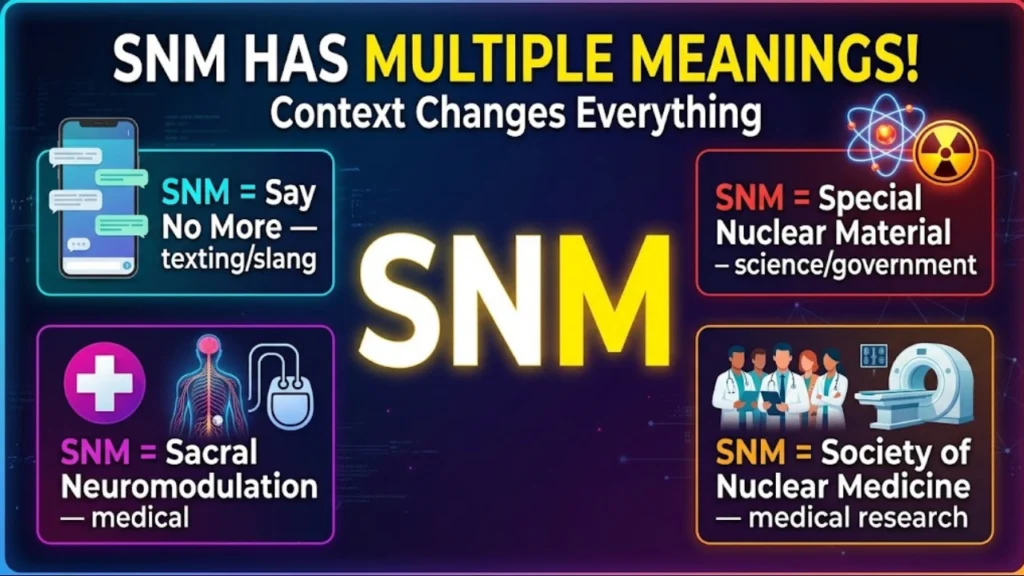
Text slang isn’t the only place SNM shows up. Context changes everything here, so it helps to know the alternatives.
Special Nuclear Material — a term the U.S. Nuclear Regulatory Commission uses for fissile substances involved in nuclear fission. You’ll see this in government and scientific writing, never in a text thread.
Sadism and Masochism — sometimes written as S&M, this refers to deriving pleasure from giving or receiving discomfort, often in a relationship context. Completely unrelated to the texting meaning.
Sacral Neuromodulation — a medical procedure that uses mild electrical stimulation to help the brain, bladder, and bowels communicate better. It’s used to treat bladder and bowel control issues.
Society of Nuclear Medicine — also known as SNMMI, a nonprofit organization focused on nuclear medicine and molecular imaging research.
The rule of thumb: if you see SNM in a casual text or on social media, it almost certainly means “say no more.” Anywhere more clinical or technical, it’s likely one of these other terms.
SNM vs. SM, SMN, and SMW: Clearing Up the Confusion
These four terms look almost identical, and that’s exactly why people mix them up. Here’s a clear breakdown.
What does SMN stand for in chat? SMN is essentially the letters of SNM rearranged, usually by accident. Typing fast on a phone keyboard makes letter swaps common, and SMN almost always carries the same intended meaning as SNM — “say no more.”
What is SM in Gen Z slang? This one’s genuinely different. SM stands for “so much,” as in “I miss you sm” or “thank you sm.” It’s an intensifier, not an acknowledgment. Don’t confuse it with SNM — they serve completely different jobs in a sentence.
What is SMW in chat? SMW is less common and more context-dependent, often used loosely to mean “someone” or as shorthand within a specific friend group or platform trend. Unlike SNM, it doesn’t have one fixed, widely recognized meaning — always check the context of the conversation before assuming what it means.
Term
Meaning
Example
SNM
Say no more
“SNM, I’m on it.”
SM
So much
“Love you sm.”
SMN
Typo/variant of SNM
Same use as SNM
SMW
Context-dependent
Varies by chat
FAQ’s
What does SNM mean in chat?
It means “say no more.” The person understands and doesn’t need extra explanation.
What is SM in Gen Z slang?
SM means “so much,” used to add emphasis, like “I appreciate you sm.”
What does SNM mean?
SNM stands for “say no more,” used to show agreement or understanding without needing more details.
What does SMN stand for in chat?
SMN is typically a typo of SNM and carries the same meaning: “say no more.”
What is SMW in chat?
SMW doesn’t have one fixed meaning. It changes based on context and is far less standardized than SNM.
Conclusion
SNM is a small acronym doing a big job: it tells someone their message was understood, no further explanation needed. Once you know the difference between SNM, SM, SMN, and SMW, texting slang gets a lot less confusing — and you’ll never second-guess a reply again.
Jack Waseem is the founder and lead editor of MeaningsLoop. He started the site out of a simple frustration: too many word-meaning searches online led to cluttered pages, thin definitions, and content clearly written for search engines rather than for people. Jack set out to build something closer to a well-kept paper dictionary — dependable, clearly written, and genuinely useful.