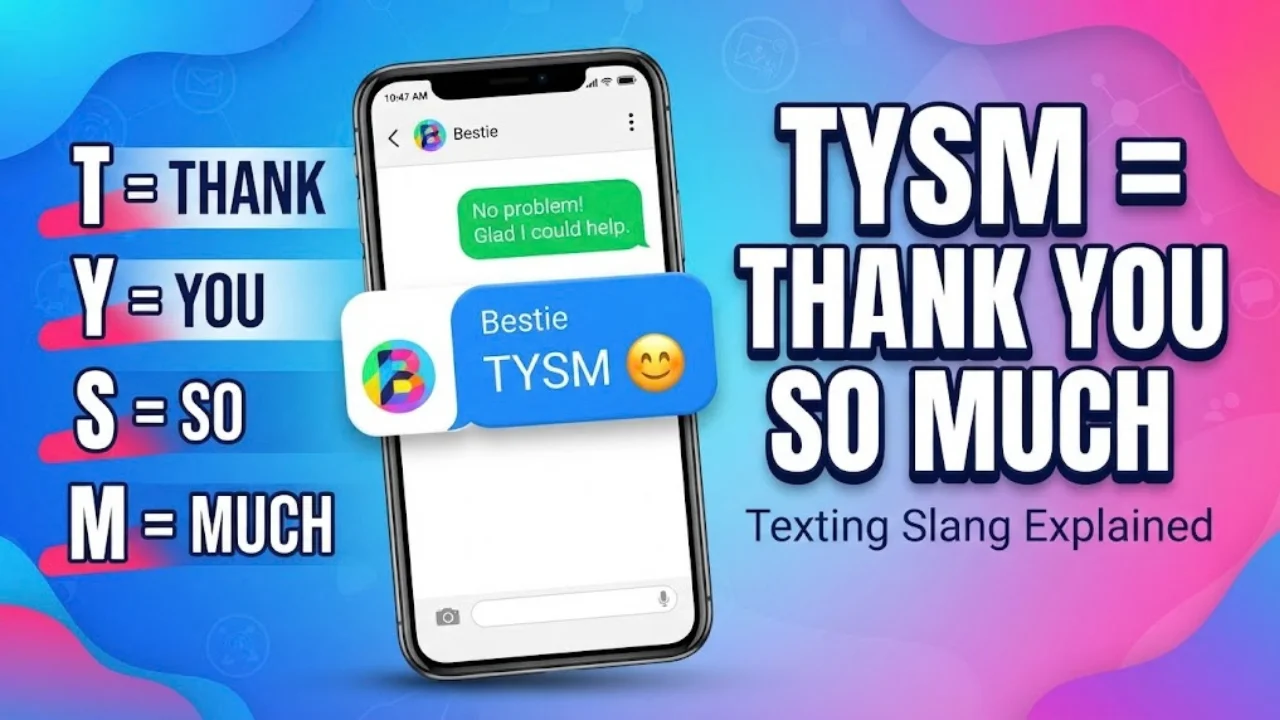
TYSM meaning in text is simple. It stands for “thank you so much.” It is a quick, friendly way to show gratitude in a chat.
You will see it in text messages, DMs, Instagram comments, and group chats. But the same three letters can sound warm, playful, or even sarcastic. This guide helps you read it right.
Table of Contents
What Does TYSM Mean in Text?
TYSM is an initialism for thank you so much. It is informal internet slang, and dictionaries like Babel Free list it that way.
Here is how the letters break down:
| Letter | Word |
|---|---|
| T | Thank |
| Y | You |
| S | So |
| M | Much |
People use it because it is fast. It also feels warmer than a plain “thanks.” The extra “so much” adds appreciation with almost no typing.
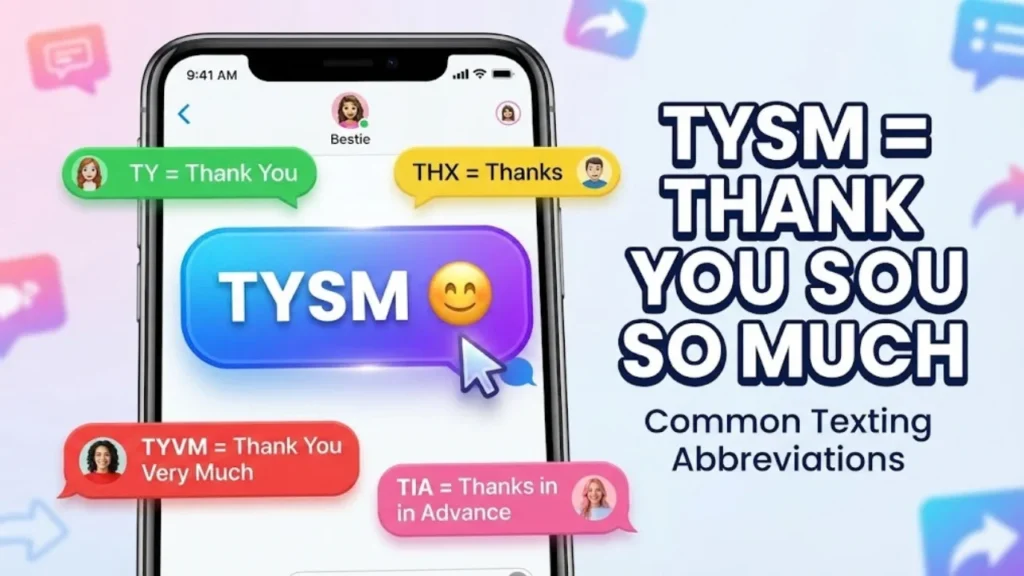
Here is how TYSM compares with other texting abbreviations for thanks:
| Short form | Full form | Feel |
|---|---|---|
| TY | Thank you | Mild |
| THX | Thanks | Very casual |
| TYVM | Thank you very much | Strong |
| TYSM | Thank you so much | Warm and strong |
| TIA | Thanks in advance | Used before help arrives |
TYSM Meaning in Text: Uses, Examples & Replies
TYSM fits any casual moment where someone helped you or did something kind. Think of it as a thank-you shortcut for everyday chats.
Young Americans live in these chat spaces. Pew Research Center’s 2024 survey found that nearly half of U.S. teens say they are online almost constantly. It also found that about six in ten use TikTok and Instagram, and 55% use Snapchat. That is a big stage for short slang like TYSM. pewresearch
Here are real-style examples:
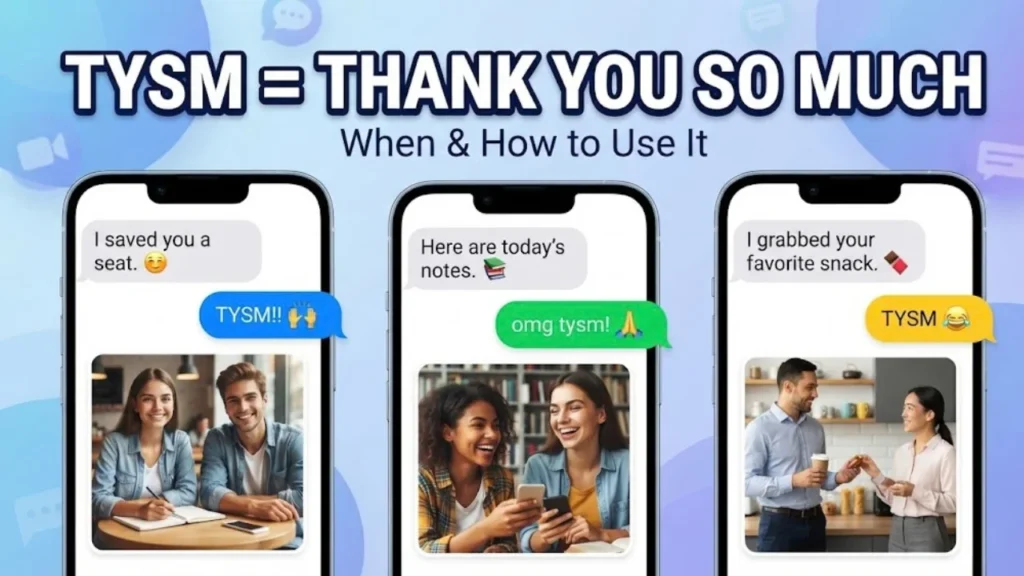
- Friend: I saved you a seat. You: tysm!!
- Classmate: Here are today’s notes. You: omg tysm, you saved me
- Sibling: I grabbed your favorite snack. You: TYSM 😂
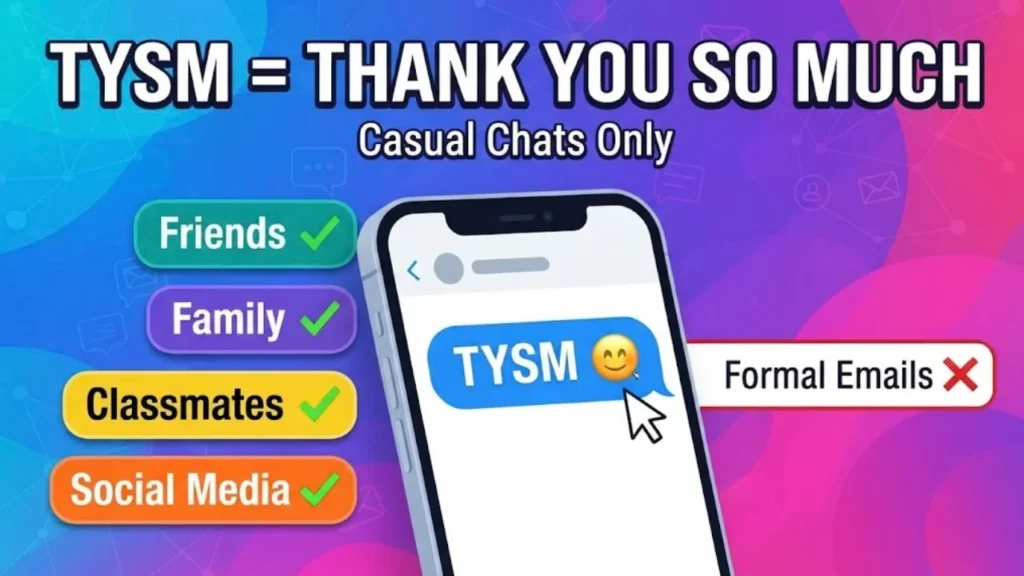
When should you use TYSM? Use it with friends, family, classmates, and on social media.
When should you avoid it? Skip it in work emails, job applications, and school essays. Write “thank you so much” or “I truly appreciate your help” instead.
How do you reply to TYSM? Keep it short:
- “You’re welcome!”
- “No problem.”
- “Anytime.”
- “Happy to help.”
- “My pleasure.”
Must Visit: MHM Meaning in Text: The Surprising Truth Behind “MHM” in Chat
The Hidden Truth Behind TYSM Meaning: Tone, Sarcasm & Gen Z Style
The letters stay the same, but the tone can change. In text, there is no voice or face, so small clues carry the mood.
The hidden truth is that TYSM is not always sincere. Because it is so quick to type, some people send it on autopilot. Others use it as a jab.
Here is how the tone shifts:
| Style | Example | Likely feel |
|---|---|---|
| Lowercase + emoji | tysm 😊 | Warm and relaxed |
| Caps + extra marks | TYSM!!! 🎉 | Excited |
| Full stop | Tysm. | Flat or neutral |
| Sarcastic add-on | tysm for nothing | Annoyed |
| Chat-ender | ok tysm, bye | Wants to wrap up |
Gen Z often types in lowercase and adds emojis or words like “omg” and “bestie.” That usually reads as casual and friendly.
A quick tip: read the whole message, not just the three letters. Look at the punctuation, the emojis, and what came before it.
FAQ’s
What does tysm mean in gen z?
It means “thank you so much,” the same as everywhere else. Gen Z often types it in lowercase with emojis. Depending on the message, it can sound sincere, playful, or sarcastic.
What does TYSM mean in Urdu?
TYSM in Urdu means “بہت بہت شکریہ” (bohat bohat shukriya). Many Urdu speakers also just say “bohat shukriya” for a shorter thank-you.
What is Ttyl in Gen Z?
TTYL means “talk to you later.” It is a chat sign-off, not a thank-you. You might see both in one message: “ttyl, tysm for the help!”
What does tysm mean to a guy?
It means the same thing: thank you so much. When a guy sends it, he is usually just showing thanks. The word is not a romantic signal on its own. Emojis, timing, and the rest of the chat set the tone.
Conclusion
TYSM meaning in text is “thank you so much.” It is quick, warm, and made for casual chats.
Watch the tone. Emojis, punctuation, and context can turn a thank-you into a joke or a jab. In formal writing, spell it out.

Jack Waseem is the founder and lead editor of MeaningsLoop. He started the site out of a simple frustration: too many word-meaning searches online led to cluttered pages, thin definitions, and content clearly written for search engines rather than for people. Jack set out to build something closer to a well-kept paper dictionary — dependable, clearly written, and genuinely useful.